

The Burrow

Nov 4, 2026
Smoking can take a toll on your health, but the financial cost can be significant too. With cigarette prices continuing to rise, what might seem like a small daily expense can add up to hundreds of thousands of dollars over a lifetime. Beyond the cost of cigarettes, smoking can also bring additional expenses, including potential healthcare costs and health insurance considerations.
Whether you’re a regular smoker or thinking about quitting, understanding the long-term financial impact of smoking can help put the habit into perspective. The money spent on cigarettes or healthcare costs could instead go towards savings, everyday bills or other financial goals, making it worth looking at the bigger picture.
To find out, the health insurance comparison experts at Compare the Market analysed official Australian smoking data and historical cigarette prices to estimate how much someone could spend on cigarettes over their lifetime. The analysis looks at the cost of smoking daily from age 17 to 85, how spending differs across generations, and how much money could be saved by quitting or potentially accumulated through investing instead.
| Year | Price per stick | Pack of 20 | Pack of 20, in 2026 dollars |
| 1972 | $0.02 | $0.36 | $4.81 |
| 1980 | $0.04 | $0.86 | $4.78 |
| 1990 | $0.12 | $2.34 | $5.98 |
| 2000 | $0.29 | $5.83 | $11.98 |
| 2010 | $0.59 | $11.83 | $18.09 |
| 2020 | $1.54 | $30.73 | $38.88 |
| 2026 | $2.44 | $48.77 | $48.77 |
Disclaimer: Estimated average price of a mainstream factory-made cigarette each year, based on the ABS tobacco price index, anchored to Cancer Council’s September 2025 mainstream average (a major tobacconist’s online prices) and aligned to recorded recommended retail prices from 1980 to 2022. Before 1980, there was no recorded price to align to, so 1972 holds the 1980 alignment and is less certain than later years. 2026 is the year’s average; from 1 September 2026, a pack is $49.73. 2026 dollars use the ABS Consumer Price Index.
Cigarette prices have risen sharply over the past few decades, making smoking an increasingly expensive habit. In 1980, a pack of 20 cost $0.86, equivalent to $4.78 in 2026 dollars after adjusting for inflation. By 2026, the average price had reached $48.77. The steepest decade was 2010 to 2020, when the inflation-adjusted price of a pack of cigarettes more than doubled, rising from $18.09 to $38.88. Increases in tobacco excise have played a major role in driving up prices over time.
And the cost could keep climbing. Under the central projection, a pack of 20 cigarettes could cost $64.33 by 2035 and pass $100 by 2050. These are projected prices at the time, including inflation. In today’s money, the 2050 price would be equivalent to $55.56, suggesting cigarettes could become more expensive even after accounting for general price rises.
These projections assume current tobacco excise settings continue, with future prices partly dependent on wage growth. While the exact cost will depend on how prices change, the trend highlights how much more smokers could pay in the years ahead. For someone who smokes daily, even small increases in the price of a pack can add up over weeks, months, and years.
| Daily smokers by age | Cigarettes per day | Cost per day | Cost per week | Cost per year |
| Average daily smoker, 15 and over | 11.7 | $29.09 | $203.66 | $10,619 |
| 15 to 17 | 4.1 | $10.20 | $71.37 | $3,721 |
| 18 to 24 | 7.2 | $17.90 | $125.33 | $6,535 |
| 25 to 34 | 8.9 | $22.13 | $154.92 | $8,078 |
| 35 to 44 | 11.8 | $29.34 | $205.40 | $10,710 |
| 45 to 54 | 13.2 | $32.82 | $229.77 | $11,981 |
| 55 to 64 | 14.2 | $35.31 | $247.17 | $12,888 |
| 65 and over | 12.5 | $31.08 | $217.58 | $11,345 |
Disclaimer: Cost at the estimated price from 1 September 2026 ($2.48665 a stick, $49.73 a pack), at the ABS National Health Survey 2022 average cigarettes a day for people who smoke daily. ABS says the 15 to 17 figure (4.1 a day, relative standard error 34%) should be used with caution. Estimates, not what any person spends.
The price of a pack is only part of the picture. How much someone spends also depends on how many cigarettes they smoke each day, and the latest estimates show just how quickly the costs can add up.
The average daily smoker spends an estimated $10,619 a year on cigarettes. That’s around $29 a day, or more than $200 a week. Over a year, that could make a meaningful difference in savings or other household expenses.
Spending also varies by age. Smokers aged 55 to 64 spend the most on average, at an estimated $12,888 a year, while those aged 18 to 24 spend around $6,535. Younger smokers may spend less each year, but the longer someone continues smoking, the more those costs can accumulate.
To understand the longer-term impact, we looked beyond today’s spending to estimate what cigarettes could cost over the years ahead.
| Age in 2026 | Still to spend, low | Still to spend, central | Still to spend, high | Lifetime total, central | Lifetime total, central, in 2026 dollars |
| 17 | $1,460,627 | $2,499,775 | $4,592,386 | $2,503,424 | $871,090 |
| 20 | $1,363,784 | $2,265,645 | $4,004,778 | $2,286,007 | $855,662 |
| 25 | $1,212,767 | $1,918,164 | $3,184,847 | $1,960,841 | $827,461 |
| 30 | $1,069,604 | $1,613,716 | $2,524,683 | $1,675,391 | $792,092 |
| 35 | $936,694 | $1,349,268 | $1,994,257 | $1,425,105 | $750,713 |
| 40 | $805,565 | $1,112,078 | $1,560,143 | $1,205,719 | $705,270 |
| 45 | $684,678 | $906,701 | $1,210,623 | $1,013,804 | $657,028 |
| 50 | $569,452 | $725,236 | $925,209 | $845,139 | $604,610 |
| 55 | $463,238 | $568,089 | $694,486 | $697,024 | $548,690 |
| 60 | $362,620 | $429,401 | $505,090 | $567,220 | $491,053 |
| 65 | $272,042 | $311,449 | $353,453 | $453,492 | $432,071 |
| 70 | $194,956 | $215,492 | $236,090 | $355,326 | $373,730 |
| 75 | $124,299 | $132,787 | $140,809 | $271,004 | $316,819 |
| 80 | $59,489 | $61,486 | $63,267 | $198,974 | $262,444 |
| 85 | $0 | $0 | $0 | $137,138 | $209,961 |
Disclaimer: A person who has smoked daily since 17 and keeps smoking daily to 85, at the ABS average cigarettes a day for each age. Still to spend runs from 2027 to 85 at prices projected under current excise settings (low, central and high wage growth); lifetime adds spending so far. 2026 dollars adjust past spending by the ABS Consumer Price Index and future spending by 2.5% a year. Proposals to freeze or cut excise are not government policy as at October 2026. Estimates, not predictions: no quitting.
The long-term figures highlight how much cigarette spending can accumulate over time. Under the central projection, someone who starts smoking daily at 17 and continues until age 85 could spend around $2.5 million on cigarettes in projected future dollars. When adjusted for inflation, that lifetime cost is estimated at $871,090 in 2026 dollars.
The projected cost remains substantial for older smokers, too. A 30-year-old who continues smoking daily could spend another $1.61 million by age 85 under the central projection, while a 60-year-old could spend another $429,401. These estimates reflect projected future prices, rather than what that spending would be worth in today’s money.
Future cigarette prices make the long-term estimates less certain, particularly for younger smokers who have more years of spending ahead. For a 17-year-old, the projected remaining cost ranges from around $1.46 million under the low scenario to $4.59 million under the high scenario. These are estimates rather than predictions, and assume the person continues smoking daily until age 85.
Even smoking occasionally can add up over time. Someone who smokes mainly when drinking, for example, could spend around $2,586 a year on cigarettes by getting through just one pack each weekend, based on the current price of $49.73 per pack.
| Generation | Birth years | Age in 2026 | Started smoking | Spent so far | Still to spend, central | Lifetime total, low | Lifetime total, central | Lifetime total, high | Lifetime total, central, in 2026 dollars |
| Gen Z | 1995 to 2009 | 24 | 2019 | $37,692 | $1,984,765 | $1,280,756 | $2,022,456 | $3,373,315 | $833,597 |
| Millennials | 1980 to 1994 | 39 | 2004 | $90,478 | $1,156,708 | $921,311 | $1,247,187 | $1,729,946 | $714,383 |
| Gen X | 1965 to 1979 | 54 | 1989 | $126,679 | $598,398 | $611,136 | $725,078 | $864,153 | $560,039 |
| Baby Boomers | 1946 to 1964 | 71 | 1972 | $139,444 | $197,954 | $319,773 | $337,398 | $354,864 | $362,138 |
| Starting today (youngest Gen Z) | Turns 17 in 2026 | 17 | 2026 | $3,649 | $2,499,775 | $1,464,276 | $2,503,424 | $4,596,035 | $871,090 |
Disclaimer: One representative person per generation, born in the middle year of its McCrindle birth years, smoking daily from 17 to 85 at the ABS average cigarettes a day for each age. ‘Starting today’ turns 17 in 2026. Estimates, not predictions: no quitting, current excise settings.
The cost of smoking looks different across generations, partly because each has experienced different cigarette prices over their lifetime. However, when past spending is adjusted for inflation, the figures show how substantial the financial impact can be for both older and younger smokers.
The estimated lifetime cost in 2026 dollars rises from $362,138 for Baby Boomers to $560,039 for Gen X and $714,383 for Millennials. For Gen Z, the projected figure reaches $833,597. Someone starting smoking at 17 in 2026 could face an estimated lifetime cost of $871,090 in today’s money.
For younger generations, much of that cost is still ahead. In the representative Gen Z scenario, a 24-year-old who started smoking in 2019 has spent an estimated $37,692 so far, with a further $1.98 million in projected spending under the central scenario. This illustrates how a recurring expense can become a much larger financial commitment over time.
These figures assume daily smoking from age 17 to 85, with no quitting, and use current tobacco excise settings for the projections. Treat them as estimates, not predictions of what any individual will spend.
| Ages | Spent in these years, in 2026 dollars | Spent in these years, in the dollars of each year | Saved by quitting at the start of these years, in 2026 dollars |
| 17 to 29 | $91,926 | $108,635 | $871,090 |
| 30 to 39 | $101,731 | $158,630 | $779,164 |
| 40 to 49 | $129,164 | $256,501 | $677,433 |
| 50 to 59 | $149,093 | $378,558 | $548,269 |
| 60 to 69 | $152,994 | $494,212 | $399,176 |
| 70 to 79 | $151,327 | $628,219 | $246,182 |
| 80 to 85 | $94,855 | $478,668 | $94,855 |
| Lifetime, 17 to 85 | $871,090 | $2,503,424 |
Disclaimer: A person who turns 17 and starts smoking daily in 2026, at the ABS average cigarettes per day for each age and the central projected price under current excise settings. 2026 dollars reduce future spending by 2.5% a year. ‘Saved by quitting’ is everything from that age to 85; quitting at 17 means never starting. The first band (17 to 29) covers 13 years and the last (80 to 85) six. Estimates, not predictions.
While the projected lifetime cost of smoking is substantial, the figures also show how much future spending could be avoided by quitting. The earlier someone quits, the more years of cigarette spending they could potentially avoid.
For someone who starts smoking at 17, quitting at age 30 could avoid an estimated $779,164 in future spending, measured in 2026 dollars. That potential saving falls to $548,269 for someone who quits at 50 and $399,176 for someone who quits at 60.
Quitting later in life can still make a difference to your finances. Someone who quits at 70 could avoid an estimated $246,182 in future cigarette spending, while quitting at 80 could save around $94,855. These estimates show that it’s not only younger smokers who could benefit financially from stopping.
Of course, the benefits of quitting extend beyond money. But looking at the potential savings can provide another perspective on the long-term impact of smoking, particularly when household budgets are under pressure.
| Generation | Spent so far | Invested at 7.3%, worth at end of 2026 | Invested at 9.0%, worth at end of 2026 | Lifetime invested at 7.3%, worth at 85, in 2026 dollars | Lifetime invested at 9.0%, worth at 85, in 2026 dollars |
| Gen Z | $37,692 | $48,466 | $51,432 | $4,570,337 | $9,460,614 |
| Millennials | $90,478 | $158,394 | $184,208 | $3,308,425 | $6,369,136 |
| Gen X | $126,679 | $290,356 | $373,363 | $2,079,308 | $3,709,481 |
| Baby Boomers | $139,444 | $409,561 | $584,338 | $1,007,541 | $1,642,063 |
| Starting today (youngest Gen Z) | $3,649 | $3,770 | $3,797 | $4,899,198 | $10,261,912 |
Disclaimer: Illustrative, not financial advice. Each year’s spending invested in equal monthly amounts at 7.3% a year (median balanced super fund since 1992, after investment fees and taxes, SuperRatings) or 9.0% a year (Australian shares over 30 years, an index return with no costs or taxes deducted, Vanguard).
The money spent on cigarettes could also have had the potential to grow if it had been invested. The outcome would depend on when the money was invested, how much was contributed, and the returns achieved over time.
For example, a Baby Boomer’s estimated $139,444 in lifetime cigarette spending so far could have grown to around $409,561 by the end of 2026 under the illustrative 7.3% annual return scenario. At a 9% annual return, the figure would be $584,338.
Younger generations have more time for potential investment growth to compound. Under the model, a Gen Z smoker’s lifetime cigarette spending could grow to around $4.57 million at a 7.3% annual return, or $9.46 million at 9%, by age 85, measured in 2026 dollars.
These figures illustrate what may be possible under the model’s assumptions, rather than guaranteed outcomes. Investment returns can vary, and actual results would depend on market performance and other factors. They are not financial advice, but they highlight the opportunity cost of spending money on cigarettes over many years.
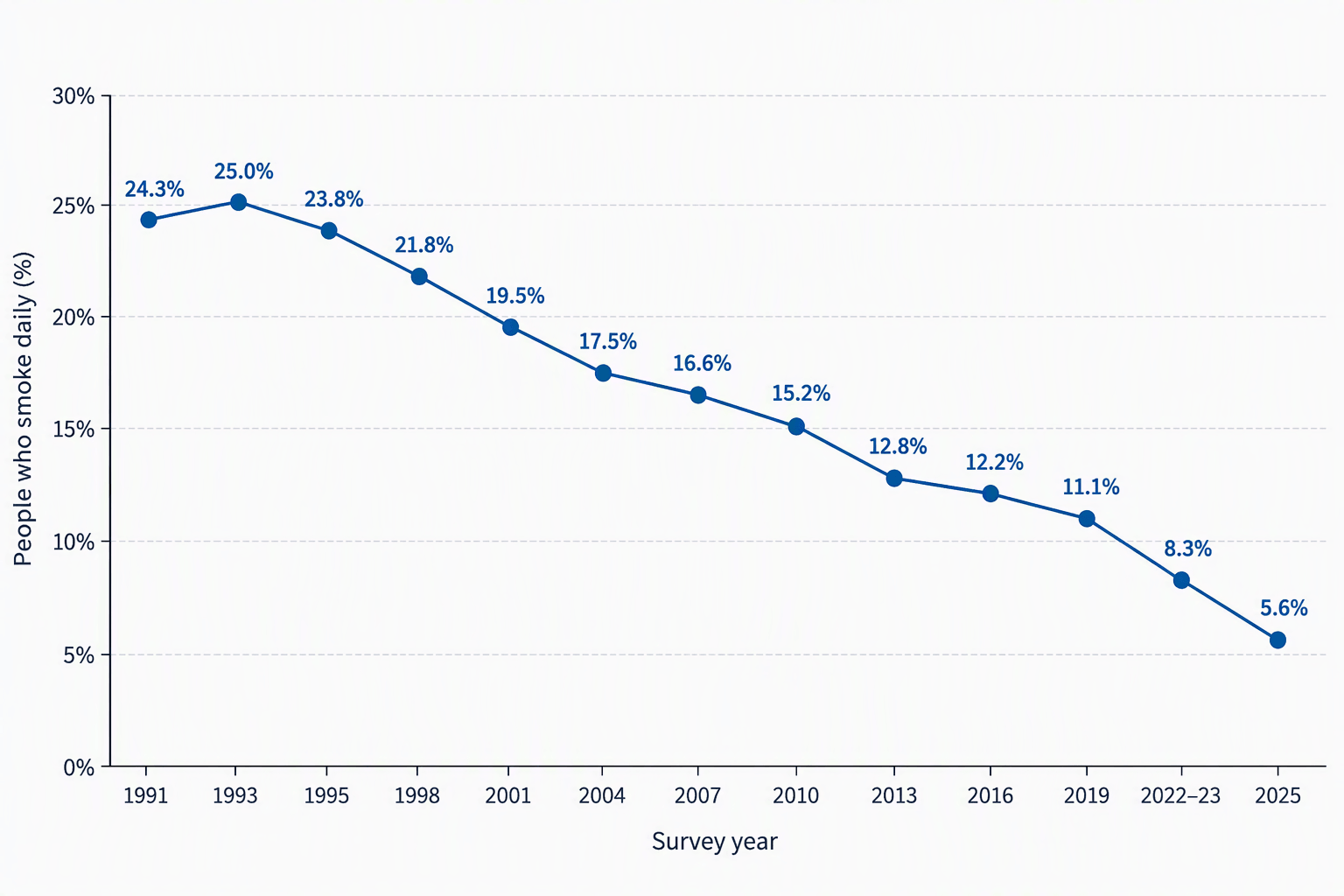
Source: AIHW, National Drug Strategy Household Survey 2025, Tables 1.1 and 1.3. The 1991 figure includes people who smoked on most days, and in 1993 only people aged 20 and over were asked. The fall between 2022-23 and 2025 is statistically significant. Numbers of people are AIHW estimates, published from 2001.
The proportion of Australians who smoke daily has fallen considerably over the past few decades. In 2025, 5.6% of Australians aged 14 and over smoked daily, down from 19.5% in 2001. The estimated number of daily smokers has also dropped from around three million to 1.3 million.
Smoking and vaping habits vary by age. Among 18- to 24-year-olds, 8.3% vape daily, compared with 2.7% who smoke daily. Vaping is also common among 25- to 29-year-olds, with 13.4% currently vaping. However, from age 40 onwards, daily smoking is more common than daily vaping.
Nicotine pouch use is also concentrated among younger adults, with 8.4% of 18 to 24-year-olds reporting use in the past 12 months, compared with 1.8% of Australians aged 14 and over.
While daily smoking has become less common, the cost remains significant for those who continue. These age differences also highlight how nicotine use is changing across generations.
| Rank (1 = highest) | State or territory | Daily smoking, 2022-23 | 2019 | 2001 | Change since 2001 (points) | Fall since 2001 |
| 1 | Northern Territory | 13.1% | 14.7% | 27.9% | -14.8 | 53% |
| 2 | Tasmania | 11.3% | 12.8% | 20.6% | -9.3 | 45% |
| 3 | Queensland | 10.5% | 13.5% | 21.0% | -10.5 | 50% |
| 4 | South Australia | 9.0% | 11.9% | 20.1% | -11.1 | 55% |
| 5 | Western Australia | 7.7% | 11.9% | 20.0% | -12.3 | 62% |
| 6 | Victoria | 7.6% | 10.2% | 19.2% | -11.6 | 60% |
| 7 | New South Wales | 7.5% | 9.5% | 18.0% | -10.5 | 58% |
| 8 | Australian Capital Territory | 4.8% | 8.2% | 18.4% | -13.6 | 74% |
| Australia | 8.3% | 11.0% | 19.4% | -11.1 | 57% |
Source: AIHW, National Drug Strategy Household Survey 2022-23, Tables 9b.4 and 9b.6, people aged 14 and over. New South Wales, Victoria and Western Australia are within the margin of error of each other, as are the Northern Territory, Tasmania and Queensland. South Australia, New South Wales, Victoria and Western Australia are each within their margin of error of the national rate. National figures are as published with the 2022-23 state tables; the 2025 release revises 2001 to 19.5% and 2019 to 11.1%, as in the ‘Who is still smoking?’ table. 2025 state results are due at the end of 2026.
Smoking rates also vary across Australia. The latest state and territory figures for 2022-23 show the Northern Territory had the highest daily smoking rate (13.1%), followed by Tasmania (11.3%) and Queensland (10.5%). The Australian Capital Territory had the lowest rate, at 4.8%.
Despite these differences, daily smoking rates have fallen across every state and territory since 2001. The ACT recorded the largest relative decline, down 74% from 18.4%, while Tasmania saw the smallest decline, at 45%.
Based on the latest available state figures from 2022-23, daily smokers in New South Wales, Queensland and Victoria would each spend between around $4.6 billion and $5.5 billion a year on cigarettes at legal retail prices. Smoking rates have since fallen, and the latest national figures from 2025 provide a more up-to-date picture of the potential annual cost across Australia.
Nationally, the estimated potential spend is around $13.8 billion a year, or $38 million a day, based on the latest 2025 smoking figures. However, this is a modelled estimate rather than a measure of actual spending. It assumes all cigarettes are bought at legal retail prices. Still, tobacco tax receipts have nearly halved in a year, suggesting actual spending on legal cigarettes is likely to be around half this estimate.
Steve Spicer, Executive General Manager – Health Insurance at Compare the Market, says: “Smoking can have a lasting impact on both your health and your finances. While the cost of cigarettes is something people can calculate, the potential cost of managing smoking-related health conditions can be harder to predict.
“Understanding what your health insurance covers is one way to be more informed about potential healthcare expenses. Depending on your level of cover, private health insurance may help with eligible hospital treatment, but it doesn’t cover every medical cost. Out-of-pocket expenses, waiting periods, exclusions and policy limits can all affect what you pay.
“If you’re reviewing your health insurance, it’s worth checking whether your current policy suits your needs, what services are included, and where you could still face costs. Comparing policies can help you understand your options, while quitting or cutting down on smoking remains one of the most important steps you can take to improve your long-term health.”
The Lifetime Cost of Smoking report estimates what Australians who smoke spend on cigarettes over a lifetime, and what that money could have become if invested instead. It combines official data on who smokes and how much, a cigarette price for every year from 1958, and future prices projected under current excise settings. The same model powers the calculator on this page. Every cost is an estimate for a typical daily smoker, not a record of what anyone has spent.
Vaping and nicotine pouches are context only and are not costed, as there are no reliable public prices for them.
Who Smokes, and How Much
Each person in the model starts smoking at 17, the average age at which Australians who have ever smoked had their first full cigarette (16.8 years in 2025, rounded). In each year of life, they smoke the ABS average for people of that age who smoke daily, from 4.1 cigarettes a day at 15 to 17 up to 14.2 at 55 to 64. These are the averages for people who smoke daily. The AIHW survey’s averages for everyone who currently smokes were higher at most ages in 2022-23 and lower in 2025.
The Price of a Cigarette
Prices are modelled per stick, because excise is charged per stick. The series follows the ABS tobacco price index, anchored to Cancer Council’s average price for a mainstream pack of 20 in September 2025 ($46.42). Because that index covers all tobacco, including loose tobacco, whose tax rose faster, it understates past cigarette prices on its own, so the series is aligned to Cancer Council’s recorded mainstream prices in 21 years from 1980 to 2022, with the index filling the gaps. Before 1972 prices follow general inflation, which Cancer Council’s historical prices for a leading brand show they broadly tracked. From 1 September 2026, a pack costs an estimated $49.73.
Projecting Future Prices
Excise rises each March and September in line with average wages, as legislated. Future prices apply this at three rates of annual wage growth from the last ten years of ABS data: the lowest (1.4%), the average (3.2%) and the highest (4.8%), so the range rests on observed wages rather than chosen numbers. The rest of the price grows 2.5% a year, the midpoint of the Reserve Bank’s inflation target, with GST on top. The central projection is the headline.
Calculating the Lifetime Cost
Spending so far adds up each year’s cigarettes at that year’s price to the end of 2026; spending still to come runs from 2027 to age 85 at projected prices. Headline figures are in 2026 dollars, because totals reaching into the 3000s are hard to compare with today’s money: past spending is adjusted with the Consumer Price Index and future spending reduced by 2.5% a year. The cost of each decade is also shown, so the saving from quitting at any age can be read off.
The calculator runs the same model for one person, from their age, starting age and cigarettes a day, or the ABS averages for readers who are not sure. With a start at 17 and the averages, it reproduces the report’s figures at every age from 18 to 85.
Limitations
Data Sources
| Data | Source | Reference period |
| Daily smoking, starting age, illicit tobacco, vaping and nicotine pouches | AIHW, National Drug Strategy Household Survey 2025 | 1991 to 2025 |
| Daily smoking by state and territory | AIHW, National Drug Strategy Household Survey 2022-23 | 2001 to 2022-23 |
| Cigarettes smoked a day, by age | ABS, National Health Survey 2022 | 2022 |
| Tobacco prices and general inflation | ABS, Consumer Price Index | 1958 to August 2026 |
| Recorded cigarette prices | Cancer Council Victoria, Tobacco in Australia, section 13.3 | 1980 to September 2025 |
| Tobacco excise rates | Australian Taxation Office, historical excise rates | November 1999 to September 2026 |
| Wage growth | ABS, Average Weekly Earnings | May 2016 to May 2026 |
| Population aged 14 and over | ABS, National, state and territory population | June 2023 and June 2025 |
| Investment returns | SuperRatings and Vanguard Index Chart | 1992 to 2026; 30 years to June 2026 |
| Generation birth years | McCrindle | Current definitions |
| Federal tobacco tax receipts | Australian Government, Final Budget Outcomes 2024-25 and 2025-26 | 2024-25 and 2025-26 |