

The Burrow

Jun 4, 2026
The rising cost of living is forcing people to re-evaluate their habits in order to try and save money. For some, cutting back on luxuries or non-essentials are not enough; they’re feeling forced to change fundamental habits of their everyday lives to reduce the cost of bills on their budget.
Energy bills are a major factor, and there are many different ways that people are changing their energy usage in an effort to combat rising living costs.
The energy comparison experts at Compare the Market surveyed over 1,000 Australian adults, as well as over 1,000 Canadian and 1,000 American adults, to see how many people are altering the way they use energy at home.
Sit back and get cozy as we explore the results.
Very few people are unaffected by the cost of living and energy bills, with most having to make some serious changes to their energy habits. Thirty per cent of Australians classed these changes as “significant”, followed by 27% of Canadians and 26% of Americans.
| How have rising living costs changed your energy usage? | Australia | Canada | USA |
| Significantly | 30% | 27% | 26% |
| Somewhat | 46% | 48% | 46% |
| Not really | 17% | 18% | 18% |
| Not at all | 6% | 7% | 9% |
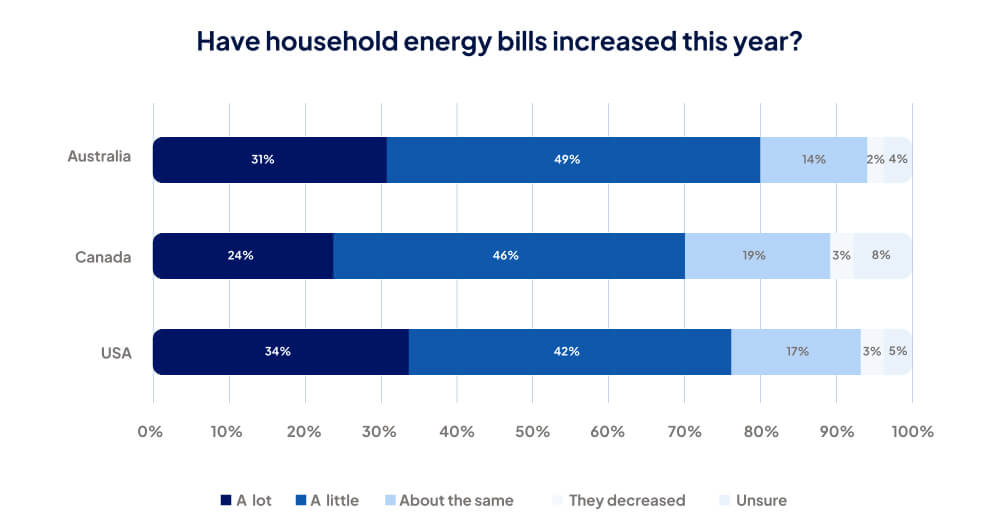
When asked whether their energy bills had increased or not, over two-thirds in each nation had said they had risen. Americans saw the most severe increase, with 34% saying they had risen “a lot”, compared to 31% of Australians and 24% of Canadians.
In each country, fewer than 20% said their bills stayed roughly the same, and a tiny number said they had actually seen a decrease in energy bills.
Energy bills are putting pressure on households across the world. In Australia, 19% said it was their biggest financial pressure, while 46% said it was a moderate source of pressure, and 23% said other cost-of-living stresses were taking focus.
Americans were in a similar position, with 18% saying it was their biggest financial pressure, 43% saying it was moderate, 25% saying it was a minor concern.
Canadians were feeling the pressure from energy bills to a lesser degree, with 13% saying it was their biggest concern, while 43% saying it was a moderate source of financial pressure.
Given that heaters, air-conditioning and laundry machines are some of the most energy-intensive machines in the home, it’s not surprising that a majority of respondents said they were changing the way they use them.
Australians were the most likely to cut back on heating and air-con, at 54%, followed by 45% of Americans and 38% of Canadians. Interestingly, Canadians and Americans were more likely to adjust heating and cooling settings than Australians, at 48%, 44% and 32% respectively.
Line drying and cold-cycle washes were also popular options, as well as using appliances during off-peak times, when electricity is cheaper (for those on a time-of-use tariff). Notably, almost 40% of Australians turned to line-drying instead of using an electric dryer. This is twice than that of Canada, where only 19% of respondents said they started using a laundry line in the past 12 months to fight energy bills. Additionally, it was over three times that of America, where only 12% said they turned to laundry lines to save using a dryer.
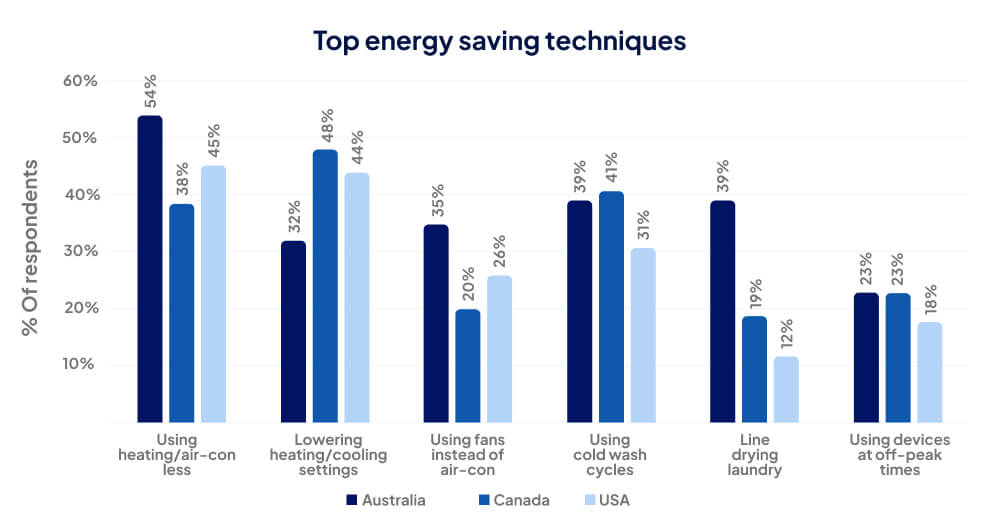
N.B. respondents could choose multiple options to answer this question, so totals do not add up to 100%.
While heating, cooling and laundry devices are some of the biggest energy guzzlers in the home, there were also other methods people were using to save energy.
Interestingly, the number one method was turning off lights and appliances more often, and this was the case for 69% of Australians, Canadians and Americans.
Almost half of Australians surveyed said they were taking shorter showers (43%), but this was the case for only 32% of Americans and 31% of Canadians. Americans and Canadians were more likely to use energy-saving light bulbs than Australians were (42% and 39% respectively, compared to 35%).
Another key difference was that Australians were more likely to reduce the use of their oven and switch to quicker meals at 21%, compared to 17% of Americans and 16% of Canadians.
The last big difference was comparing energy providers to find a cheaper or more suitable energy plan. Australians were twice as likely to compare energy plans than Canadians and Americans, with 16% of Aussies reviewing their options compared to just 7% of Canadians and Americans.
| Energy saving behaviours | Australia | Canada | USA |
| Turning off lights/appliances more often | 69% | 69% | 69% |
| Taking shorter showers | 43% | 31% | 32% |
| Using energy-saving bulbs | 35% | 42% | 39% |
| Reducing oven use & opting for quicker meals | 21% | 16% | 17% |
| Comparing energy providers to find something cheaper / more suitable | 16% | 7% | 7% |
| None of the above | 11% | 10% | 12% |
N.B. respondents could choose multiple options to answer this question, so totals do not add up to 100%.
Compare the Market’s Head of Energy, Meredith O’Brien, says that as prices change and the cost of living squeezes household budgets, comparing energy plans is always a good move.
“Comparing available energy plans is important because as prices change you don’t want to be stuck paying more than you have to. Even if rates drop, if you do nothing you may still be paying more expensive rates while other more competitively priced plans are available, which will save you more,” O’Brien says.
“You can compare energy plans to search for potentially better rates, and anything you can do to cut down on the cost of your energy usage can have an impact on your energy bill. It’s something you can do alongside other energy-saving measures at home. These things together can really help cut down on energy bills.”
“Comparing energy plans using a comparison service doesn’t take long, and it could save you money, or get you more value for your money when you search for an energy plan with perks, rewards, or a solar feed-in tariff that suits you better.”
Compare the Market commissioned PureProfile to survey 1,012 Australian, 1,013 Canadian, and 1,104 American adults in April 2026.