

The Burrow

Apr 2, 2026
It’s been more than 15 years since electric vehicles (EVs) have really entered mass market production, though some countries have been a lot faster to adopt them than others.
As more brands and models enter the market and the technology improves, the energy plan comparison experts at Compare the Market have looked back to see just how much EV battery capacity and driving range has improved.
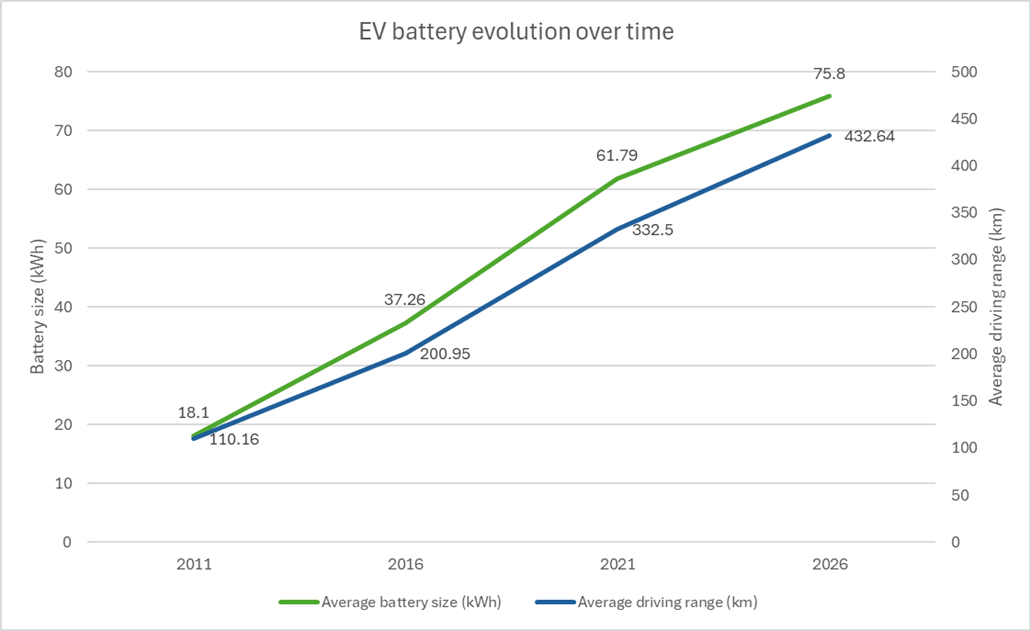
From 2011 to 2026, the average EV battery size has increased by 319%, from an average of 18.10kWh to 75.8kWh. That represents a fourfold increase over 15 years!
Driving range anxiety, which is one of the biggest concerns for people hesitant to purchase an electric car, has improved almost four times as well, increasing by 293% from an average range of 110.16km to 432.64km.
| 2011 | 2016 | 2021 | 2026 | Increase | |
| Average battery size (kWh) | 18.10kWH | 37.26kWH | 61.79kWh | 75.80kWH | 318.78% |
| Average driving range (km) | 110.16km | 200.95km | 332.5km | 432.64km | 292.74% |
N.B. These averages are not inclusive of all EV models available in a specific year.
Of course, these are just averages, and it’s possible to find EVs with even bigger batteries and driving ranges available for purchase.
The technology has greatly improved, and there are more EVs available than ever before.
For example, the 2011 average was based on five models. The 2016 figures were based on eight different electric cars, while 2021 used 14 EVs, and the numbers for 2026 were based on 20 different models – and that’s not even every EV available right now.
There were 160 different EV models available to buy in Australia at the start of 2026,1 compared to just 56 in 2022, representing an 86% increase in the number of options available in just four years.
In 2011, the EV with the biggest battery and range was the TH!NK City, a limited production model from Norway,2 with a 25kWh battery and range of 159.33km. Out of the 2026 models that were used for calculations, the model with the biggest battery and driving range was the Volvo EX60 P12 AWED. It has a 112kWh battery and 610km range.
It’s also worth noting that all the 2011 EV models were small hatchbacks, while in 2026 EVs are available as hatchbacks, sedans, SUVs and even pickups.
It’s never been a better time to become an EV owner.
The line chart below showcases the immense changes in EV battery performance over the years.
As EVs get bigger and increase their battery size, this does increase the cost of charging their battery. However, given the increased range, you need to recharge them less than a smaller EV.
For example, all things being equal, the average battery size in 2011 of 18.10kWh would have cost AUD$6.15 to recharge, assuming electricity cost a flat 34 cents per kWh.
The average 2026 EV from the selected sample would cost $25.77 to recharge a 75.8kWh battery at the same tariff.
However, the 2011 EVs had a much smaller range, and would need to recharge 3.93 times to reach the same average driving range of the 2026 EV sample. This puts the total recharge cost at $24.17, meaning the modern EVs cost $1.60 more to recharge in a comparative scenario.
So, larger EV batteries can cost more to recharge in specific situations, but the overall difference is very small.
It’s also important to remember that the older an EV gets, the more its performance begins to decline as the batteries degrade. It’s estimated that EVs lose 25% of battery capacity within eight to 10 years.3 This means the older 2011 EVs could well and truly cost more to recharge than a modern EV, as their driving range has declined – forcing owners to recharge them more often.
Compare the Market’s Head of Energy, Meredith O’Brien, notes real-world factors make the calculations even more nuanced and complex when ascertaining whether the bigger EV battery with increased range will be cheaper or more expensive to charge.
“Working out the true cost of charging an EV gets difficult when adding in several factors based on your circumstances. There are the age and efficiency of the EV battery, and we know it will have multiple recharges compared to bigger ones with more range. Individual EV models will all have different performance statistics, which can also be affected by the way you drive.
“For example, larger EVs today have more batteries to increase their capacity and range, but this adds weight. Given the way you use your car, your driving habits, whether you charge or drive in economy mode, and the number of stops and starts, you might need to recharge more often as you could be draining your battery faster than average.
“A key factor is also where, how and when you’re recharging your electric car. Are you recharging it at home or at a charging station? Charging stations are a lot faster but will cost more to use. If you recharge at home, you need to look at your energy plan to see how it affects the cost of recharging your EV.
“Do you have a time-of-use tariff, where electricity is more expensive at peak periods, but at a lower rate in off-peak times? Do you have solar panels, or a solar battery? This could help you reduce overall electricity bills by reducing the amount of energy you need from the grid.
“It’s important for EV owners to know what kind of tariff they’re on and how it could affect the cost of charging their car.”
The battery capacity and driving range of different EVs for 2011, 2016, 2021 and 2026 from Electric Vehicles Database, based on when the vehicle was available for sale. These figures were then averaged, and these averages were used to calculate the percentage increase in battery size and driving range.
References:
The specific models for each year are listed below.
2011:
2016:
2021:
2026: