
As fuel prices soar, new Compare the Market analysis seeks to address one of the key concerns holding people back from getting an EV: driving range.
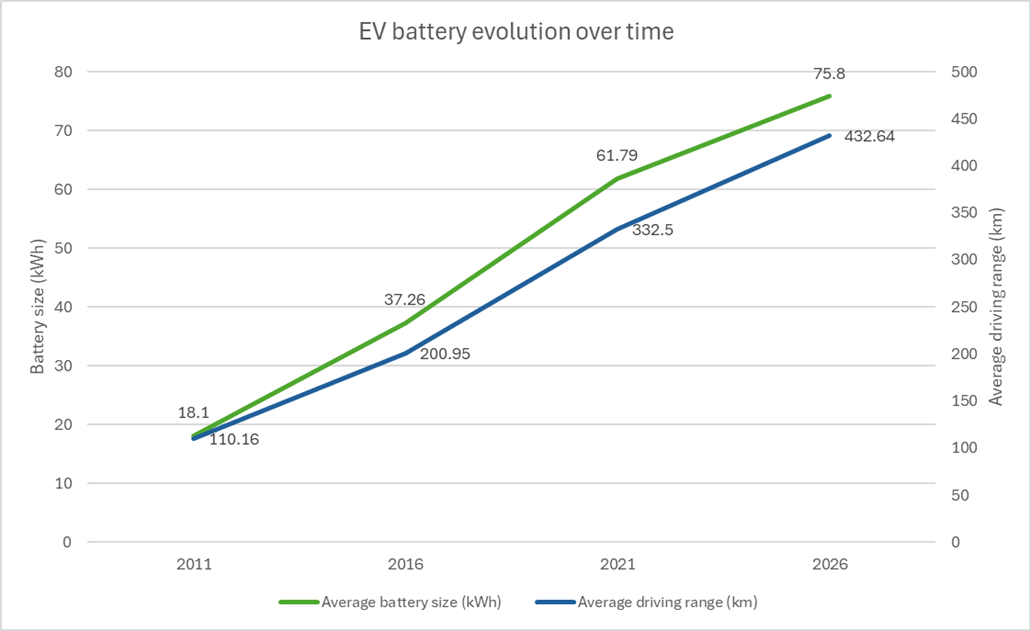
Fifteen years ago, there were only a handful of small EVs available, with an average battery size of 18.10kWh and driving range average of 110.16km (68.45 miles).
In 2026, there are dozens of EVs in a variety of sizes and body types, with the analysis finding an average battery size of 75.80kWh, and an average driving range of 432.64km (268.83 miles).
That’s an increase of 319% in battery size, and an increase of 293% in driving range.
As EVs get bigger and increase their battery size, this does increase the cost of charging their battery. However, given the increased range, you need to recharge them less than a smaller EV.
Some Australian energy retailers have also evolved their offering to provide plans that help EV owners reduce home charging costs. Compare the Market’s Head of Energy, Meredith O’Brien, explains.
“Some plans offer lower rates at night while you recharge your EV at home. Time-of-use tariffs charge more for electricity at peak times, but less at lower electricity demand times like the middle of the night or during the middle of the day, when wholesale costs are very low or negligible as renewable energy, such as solar, is being fed back into the grid. EV electricity plans often have an even lower off-peak charge rate often referred to as “super off-peak”.
“Paying attention to the time-of-use tariffs and the times they kick in can help you reduce charging costs when recharging at home. These plans offer good value for EV owners who recharge at off-peak or super off-peak times, but it’s still important to compare energy plans to ensure you’re getting the best overall deal and not missing out on potential savings.”
Ways to try to save money when charging your EV:
- If you have solar panels, charge your EV during the day when the sun is shining.
- Use a smart charger that can schedule charging, or manually start charging during off-peak times, if you have a time-of-use tariff.
- Compare energy plans to see if you can find a better deal – some energy retailers have ‘EV energy plans’ that have cheaper rates at nighttime to reduce the cost of charging overnight.
For more information on this analysis, visit: https://www.comparethemarket.com.au/energy/features/ev-battery-evolution/
Methodology
The battery capacity and driving range of different EVs for 2011, 2016, 2021 and 2026 from Electric Vehicles Database, based on when the vehicle was available for sale. These figures were then averaged, and these averages were used to calculate the percentage increase in battery size and driving range.
For interviews and more information, please contact:
James McCay | +61 450 930 374 | [email protected]
Compare the Market is a comparison service that takes the hard work out of shopping around. We make it Simples for Australians to quickly and easily compare and buy insurance, energy, and home loans products from a range of providers. Our easy-to-use comparison tool helps you look for a range of products that may suit your needs and benefit your back pocket.