


It turns out age isn’t just a number when it comes to your insurance, with new research from Compare the Market showing drivers in high-risk age groups could pay up to $1,200 more than motorists deemed to be less risky.
New road users – 17-year-olds on a P1 provisional licence – had the highest average insurance premium of all age groups ($3,897). They pay around $580 more on average than a 16-year-old learner, who may be less likely to have an accident by driving under supervision.
The data shows premiums generally fall as drivers mature and gain experience. Average costs dropped by around $1,000 for 18-year-olds with a P2 licence and improved each year thereafter until drivers hit 64. From there, driver premiums gradually rise again and reach a peak at age 99.
The comparison experts analysed quotes from eight comprehensive car insurance brands for example drivers aged between 16 and 99 years old with the same vehicle model and other driver profile details.
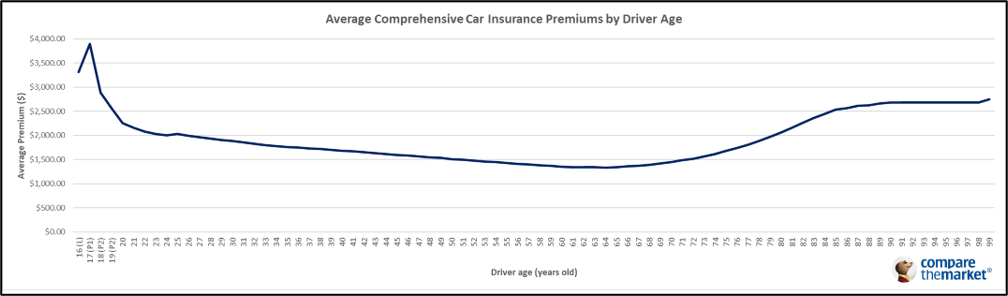
Compare the Market’s Economic Director David Koch said today’s pricing decisions were usually influenced by yesterday’s claims.
“They say the best predictor of the future is the past, and basically every time someone makes a claim it adds to the tapestry of data insurers use to calculate future risk,” Mr Koch said.
“Young drivers starting out on their provisional licence are less experienced on the roads and statistically much more likely to be in a serious crash.
“The higher the risk of an accident, the higher the premium.”
While drivers can’t change their age, Mr Koch said drivers in potentially risky groups may still be able to save by shopping around.
“All insurers have different risk appetites, and some will even cater to higher risk groups,” Mr Koch said.
“That means that while premiums for younger and older drivers may be more expensive on average, there were often much cheaper premiums available.
“In one case we found a $1,219 difference between quoted premiums for a 17-year-old P-plater. That’s not a bad bit of pocket money for 15 minutes of legwork.”
Ways for mature-aged drivers to save include restricting the driver age and adjusting the excess.
| Driver Age | Average Quoted Premium | Difference vs Previous Age |
| 16 years old (Learner) | $3,314 | |
| 17 years old (P1) | $3,897 | +17.57% |
| 18 years old (P2) | $2,886 | -25.94% |
| 19 years old (P2) | $2,556 | -11.42% |
| 20 years old | $2,255 | -11.79% |
| 21 years old | $2,157 | -4.33% |
| 22 years old | $2,079 | -3.62% |
| 23 years old | $2,036 | -2.07% |
| 24 years old | $2,002 | -1.66% |
| 25 years old | $2,030 | 1.38% |
| 26 years old | $1,995 | -1.72% |
| 27 years old | $1,963 | -1.57% |
| 28 years old | $1,935 | -1.44% |
| 29 years old | $1,905 | -1.58% |
| 30 years old | $1,882 | -1.20% |
| 31 years old | $1,856 | -1.39% |
| 32 years old | $1,824 | -1.68% |
| 33 years old | $1,799 | -1.41% |
| 34 years old | $1,780 | -1.06% |
| 35 years old | $1,761 | -1.07% |
| 36 years old | $1,746 | -0.82% |
| 37 years old | $1,735 | -0.64% |
| 38 years old | $1,719 | -0.95% |
| 39 years old | $1,701 | -1.04% |
| 40 years old | $1,681 | -1.15% |
| 41 years old | $1,668 | -0.76% |
| 42 years old | $1,649 | -1.18% |
| 43 years old | $1,632 | -0.99% |
| 44 years old | $1,616 | -1.00% |
| 45 years old | $1,600 | -1.01% |
| 46 years old | $1,583 | -1.06% |
| 47 years old | $1,566 | -1.08% |
| 48 years old | $1,549 | -1.08% |
| 49 years old | $1,532 | -1.09% |
| 50 years old | $1,511 | -1.39% |
| 51 years old | $1,495 | -1.06% |
| 52 years old | $1,479 | -1.04% |
| 53 years old | $1,464 | -1.03% |
| 54 years old | $1,448 | -1.10% |
| 55 years old | $1,427 | -1.44% |
| 56 years old | $1,413 | -0.95% |
| 57 years old | $1,400 | -0.94% |
| 58 years old | $1,382 | -1.29% |
| 59 years old | $1,370 | -0.90% |
| 60 years old | $1,357 | -0.90% |
| 61 years old | $1,346 | -0.80% |
| 62 years old | $1,342 | -0.34% |
| 63 years old | $1,339 | -0.23% |
| 64 years old | $1,332 | -0.52% |
| 65 years old | $1,341 | +0.71% |
| 66 years old | $1,358 | +1.25% |
| 67 years old | $1,372 | +1.01% |
| 68 years old | $1,395 | +1.68% |
| 69 years old | $1,421 | +1.86% |
| 70 years old | $1,450 | +2.03% |
| 71 years old | $1,484 | +2.41% |
| 72 years old | $1,522 | +2.52% |
| 73 years old | $1,567 | +2.96% |
| 74 years old | $1,617 | +3.16% |
| 75 years old | $1,681 | +3.99% |
| 76 years old | $1,741 | +3.55% |
| 77 years old | $1,813 | +4.13% |
| 78 years old | $1,891 | +4.30% |
| 79 years old | $1,969 | +4.16% |
| 80 years old | $2,065 | +4.85% |
| 81 years old | $2,160 | +4.62% |
| 82 years old | $2,269 | +5.02% |
| 83 years old | $2,363 | +4.12% |
| 84 years old | $2,450 | +3.70% |
| 85 years old | $2,540 | +3.66% |
| 86 years old | $2,562 | +0.86% |
| 87 years old | $2,615 | +2.09% |
| 88 years old | $2,624 | +0.35% |
| 89 years old | $2,664 | +1.51% |
| 90 years old | $2,683 | +0.72% |
| 91 years old | $2,683 | |
| 92 years old | $2,683 | |
| 93 years old | $2,683 | |
| 94 years old | $2,683 | |
| 95 years old | $2,683 | |
| 96 years old | $2,683 | |
| 97 years old | $2,683 | |
| 98 years old | $2,683 | |
| 99 years old | $2,755 | +2.68% |
When referencing this research, please attribute: https://www.comparethemarket.com.au/car-insurance/
Disclaimers
Compare the Market quoted a range of comprehensive car insurance policies for a 2026 Toyota Corolla Ascent Sport Hybrid hatchback on 21 May 2026 with a next-day commencement date.
Each driver age was selected, then quotes with results from all insurers were averaged to identify annual premium differences.
We assumed a driver profile for a female living in Alderley, Brisbane 4051 with no claims history, a $900 basic excess, no vehicle modifications, and no policy age restriction.
Always read the Product Disclosure Statement (PDS) and Target Market Determination (TMD) to check for the exclusions, limits and restrictions before purchasing and determine if the policy is suitable for you.
-END-