
Supermarket Shock
Average grocery spend nears $10,000 a year, as shopping habits shift
Key takeaways
- Australians reported spending an average of $186.23 a week on groceries in 2026.
- Compare the Market found shoppers could save around 43%, or up to $67.10 a week, by swapping 20 everyday brand-name items for comparable generic or home-brand products.
- The average takeaway coffee cost $5.42 in 2026; three coffees a week equated to $845.52 a year and a daily coffee to nearly $1,973 a year.


It’s one of the most stressful shops for Aussies – and it’s no wonder – with the average spend nearing $10,000 a year ($9,683.96) on groceries in 2026.
The ACT tipped the scales with an average of $210.76 a week at the supermarket – the highest in the country – with the national average at $186.23 or $806.99 a month.
Weekly grocery spend
| Location | Weekly spend groceries August 2026 |
|---|---|
| National | $186.23 |
| NSW | $188.61 |
| QLD | $180.88 |
| SA | $183.03 |
| VIC | $186.04 |
| WA | $195.40 |
| NT | $198.66 |
| ACT | $210.76 |
One in five Australians (20%) say groceries remain their most worrying household bill and compared to 2025, there’s been an increase in people taking cost-cutting measures to reduce bills at the checkout.
Concerningly, 12% of Aussies say they’re skipping meals to curb costs – up from 9.9% last year. That figure rises to 18% among both 18–24-year-olds and 35–44-year-olds.
Ways Australians are cutting supermarket costs
| Tactic | The percentage of Australians who admit to using each tactic in 2025 | The percentage of Australians who admit to using each tactic in 2026 |
|---|---|---|
| Skipping meals | 9.9% | 12% |
| Shopping in cheaper stores | 27.3% | 29% |
| Buying in bulk | 26.2% | 28% |
| Shopping online only | 4.7% | 6% |
Savvy shoppers are using a range of other tactics to cut their supermarket spend. More than half (52%) are hunting harder for discounts, 47% are planning cheaper meals and 40% are reducing food waste.
Other tactics Aussies using to lower grocery spend:
- Switching to generic brands: 34%
- Eating less meat: 26%
- Buying seasonal produce: 25%
- Buying frozen foods: 25%
Big earners spend more
The higher your income, the more likely to spend at the grocery shop. Compare the Market’s analysis shows lower income earners ($20,000 – $39,999) spend $150 on the weekly grocery shop – $91 less than the 241.37 spent on average by those earning $150k or more a year.
Weekly grocery spend based on income
| Yearly income | Weekly spend |
|---|---|
| $20-$40k | $150 |
| $40-$60k | $173 |
| $60-$80k | $184 |
| $80-$100k | $191 |
| $100-$130k | $206 |
| $130-$150k | $221 |
| $150k+ | $241 |
Hear from Compare the Market's Economic Director, David Koch:
“A lower grocery spend doesn’t necessarily mean food has become cheaper. It could be a strong sign that Australian households are fighting back. Some are changing brands or cutting out items altogether. Planning meals, reducing food waste and comparing unit prices can protect the weekly budget without requiring families to give up every small luxury.”

Average spend by age group
The average grocery spend is highest among those at the middle stages of life, with Australians aged 35 to 44 reporting the highest average spend at $221.60 a week. They were followed closely by 45-to-54-year-olds, who spent an average of $213.46.
By comparison, 18-to-24-year-olds recorded the lowest average at $147.69 a week, while Australians aged 65 and over spent $157.45.
That could partly come down to the number of people around the dinner table. Middle-aged Australians may be feeding children or teenagers, while younger Australians could be living at home or splitting costs with housemates. Older Australians may also be shopping for smaller households.
Average weekly grocery spend by age
| Age | Average spend per week |
|---|---|
| 18-24 | $147.69 |
| 25-34 | $186.07 |
| 35-44 | $221.60 |
| 45-54 | $213.46 |
| 55-64 | $182.09 |
| 65+ | $157.45 |
Average spend by household size
Household size appears to have a significant bearing on the weekly grocery bill. Couples with dependent children reported the highest average spend at $256.90 a week, while single-person households recorded the lowest at $120.92.
That’s a difference of $135.98 a week, showing the additional pressure that feeding a family can place on the household budget.
Households with adult children living at home also reported relatively high grocery costs. Couples in this position spent an average of $230.22 a week, suggesting the financial impact of feeding a family may continue well beyond the school years.
Average weekly grocery spend by household size
| Household size | Average spend per week |
|---|---|
| Single person household | $120.92 |
| Single parent with adult children living at home | $173 |
| Couple with no children | $173.56 |
| Single parent with dependent children | $216.34 |
| Couple with adult children living at home | $230.22 |
How generic brands can help Aussies pocket $3.4k a year
Switching to generic brands is another popular way shoppers are stretching their grocery budget.
Compare the Market analysed 20 everyday household items at two major supermarkets and found shoppers could save between $64.90 and $67.10 a week — around 43% — by swapping brand-name products for comparable generic or home-brand alternatives. Someone making the same shop each week could save around $290 a month or $3,489 a year by choosing the generic option every time.
Now in its second year, the analysis also uncovered sizeable price rises on individual products. Generic-brand milk climbed 55 cents (18.33%) year-on-year, while a box of home-brand wheat biscuits rose 60 cents (11.99%). The brand-name wheat biscuits increased by $1 over the same period, a 16.66% jump.
Some of the biggest price discrepancies observed in the research included:
- 1L mouthwash: $9.00
- Instant coffee: $8.50
- 1L bodywash: $8.20
- Multipurpose cleaner: $5.05
- Toilet paper: $5.00
Big little luxuries
Aussies splashing hundreds a year on coffee fix
The average Australian spends $5.42 on a single serve takeaway coffee or equivalent hot beverage in 2026.
Three takeaway coffees a week at the average price would add up to $16.26 a week, $70.46 a month or $845.52 a year.
A daily takeaway coffee may feel like a small expense, but at the average price it would cost $37.94 a week, $164.40 a month or nearly $1,973 a year.
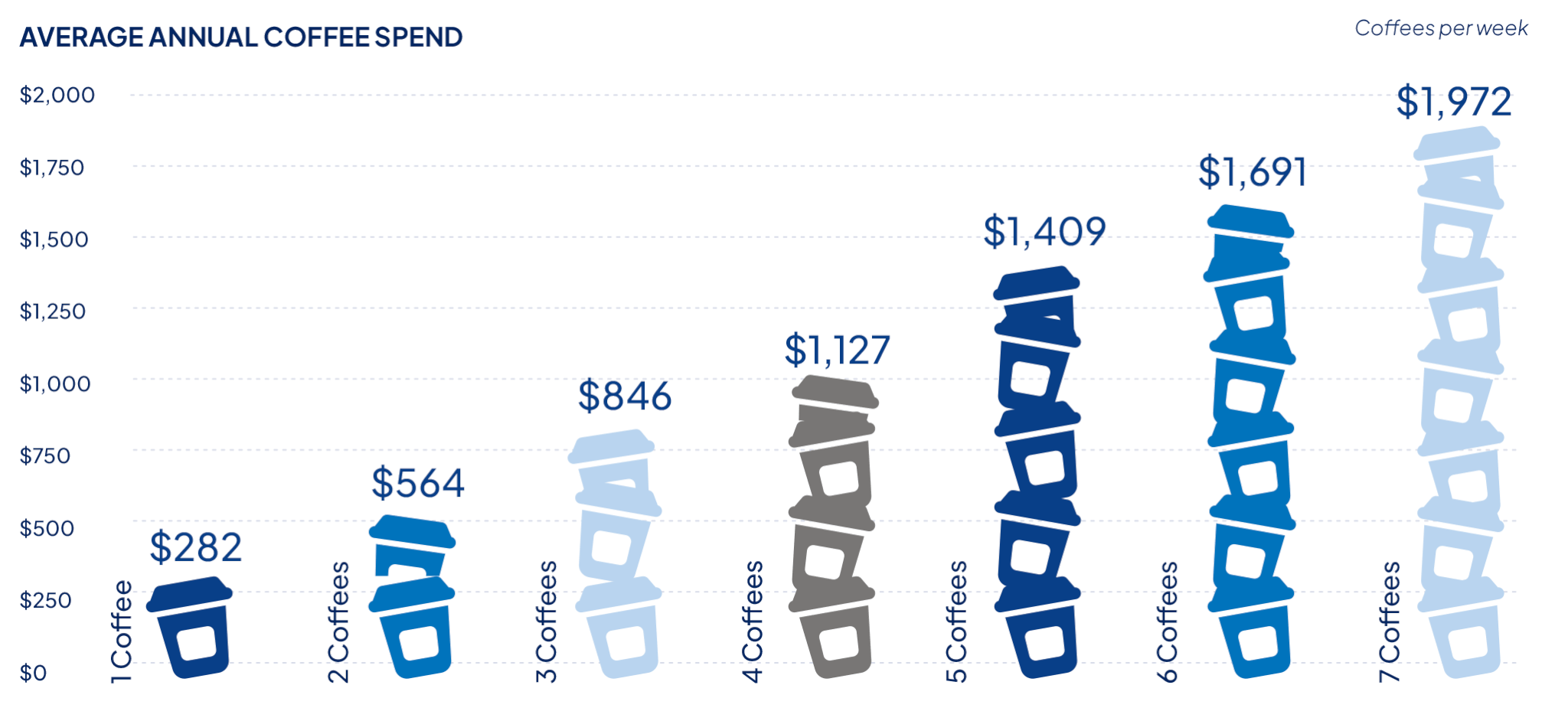
Coffee spend in numbers
| Coffees per week | Average weekly spend | Average monthly spend | Average annual spend |
|---|---|---|---|
| 1 | $5.42 | $23.49 | $281.84 |
| 2 | $10.84 | $46.97 | $563.68 |
| 3 | $16.26 | $70.46 | $845.52 |
| 4 | $21.68 | $93.94 | $1,127.36 |
| 5 | $27.10 | $117.43 | $1,409.20 |
| 6 | $32.52 | $140.92 | $1,691.04 |
| 7 | $37.94 | $164.40 | $1,972.88 |
Average coffee spend by state:
- NSW: $5.74
- QLD: $5.60
- SA: $5.38
- WA: $5.20
- VIC: $4.73
Average coffee spend by age group:
- 18-24: $5.56
- 25-34: $6.31
- 35-44: $5.00
- 45-54: $5.41
- 55-64: $5.10
- 65+: $5.44
Easy ways to spend less on your coffee habit
Brew your coffee at home
Making your coffee at home is typically much cheaper than buying takeaway. Compare the Market analysis found that a $6.50, 200g jar of instant coffee can make 50–100 cups, bringing the cost down to around 6.5–13 cents a cup.
Make loyalty programs work for you
Coffee rewards can add up over time. Regularly using loyalty programs could score you free drinks, discounts and other member perks.
Look for hidden discounts
It may be worth checking whether your insurer, energy provider, bank or other service providers offer coffee vouchers, rewards or café discounts.
Ask about concessions
Some cafés offer discounts to seniors, students or members of certain organisations. It never hurts to ask whether savings are available before you order.