
Keeping The Lights On
Energy bills remain a significant household budget concern
Key takeaways
- The median quarterly electricity bill reported in 2026 was $300, or $1,200 a year, which was $50 a quarter lower than in the 2025 report.
- 76% of surveyed Australians had changed their energy use because of rising living costs, while 36% had shopped around for an electricity or gas plan in the previous 12 months.
- Under Compare the Market’s modelled assumptions, a financed 13kW solar-only system could leave a household about $41 a month better off from day one, with an estimated 4.1-year payback; adding a battery increased the modelled monthly cost while it was being financed.


Power bill shock isn’t over
Energy remains a significant household budget concern for many Australians, even if other cost-of-living pressures are competing for attention. While some pricing benchmarks have eased in parts of the market, that does not tell the full story for households, with many customers still facing higher usage costs, daily supply charges and ongoing bill pressure.
Years of elevated energy costs have encouraged Australians to become more conscious of how and when they use power. From switching plans to changing everyday habits, households continue to look for opportunities to keep their energy costs under control.
How Australians are changing their energy habits
A pulse survey earlier in 2026 found 76% of Australians surveyed have changed their energy usage due to rising living costs.
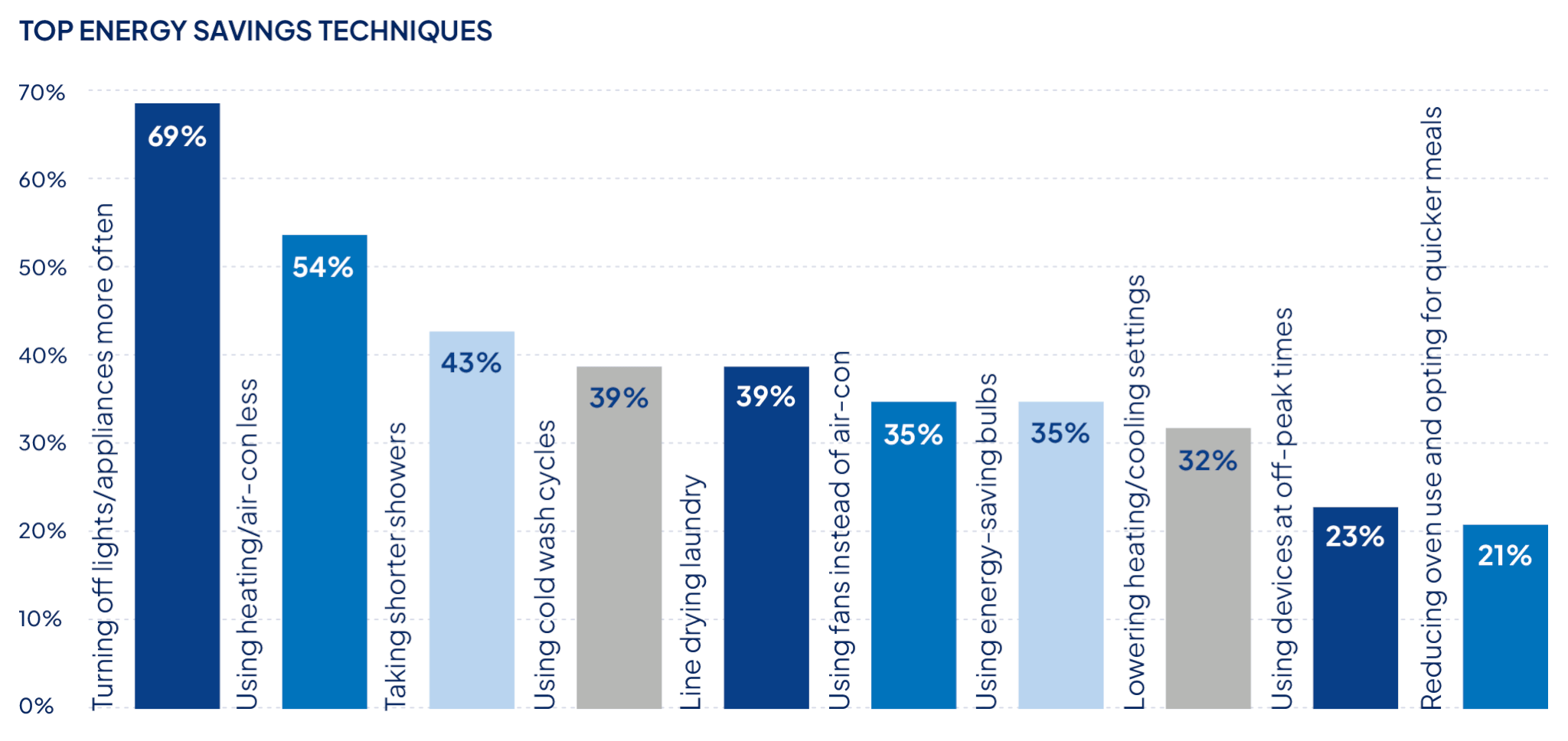
Top energy saving techniques
| Top energy saving techniques | Percentage |
|---|---|
| Turning off lights/appliances more often | 69% |
| Using heating/air-con less | 54% |
| Taking shorter shower | 43% |
| Using cold wash cycles | 39% |
| Line drying laundry | 39% |
| Using fans instead of air-con | 35% |
| Using energy-saving bulbs | 35% |
| Lowering heating/cooling settings | 32% |
| Using devices at off-peak times | 23% |
| Reducing oven use and opting for quicker meals | 21% |
Default pricing has eased in some areas, but households should stay alert
While benchmark prices dropped in some regions, households on market offers generally saw tariffs increase.
Compare the Market analysed several new market offers. In one case the daily supply charge was increasing 40% year-on-year and general usage rates were increasing 6%, while the controlled load tariff was reduced by 20%. In another example, the daily supply charge was increasing 36%, while the general usage tariff was decreasing 20%.
These examples show why headline movements in benchmark prices do not always result in cheaper bills for customers.
Hear from Compare the Market's Head of Energy, Meredith O'Brien:
“Headline movements in energy benchmarks do not always translate into a cheaper household bill, because usage rates and daily supply charges can move in different directions. Households should check the full tariff, compare plans and prioritise changes that reduce both consumption and the cost of the energy they still use. And remember to compare annually as some market offers may only last for 12 months.”

When does solar start to pay off?
Australian households and businesses are installing solar and batteries in record numbers, with more than 500,000 tapping into the government’s Cheaper Home Batteries Program.
But even with a generous discount, batteries can be expensive to buy upfront.
Compare the Market crunched the numbers and found that while batteries can give households more control over when they use their power and what they save off their energy bill, they don’t necessarily put more money back in the monthly budget while the system is being paid off.
But despite batteries delivering additional value to a growing number of households over time, it’s solar that remains the champion of savings to household’s hip pocket when taking into account the cost and benefit.
Under the modelled assumptions, even a household financing a 13kW solar system with no battery could be around $41 a month better off from day one, because the estimated energy savings outweigh the monthly repayments. On an upfront-cost basis, the system would take around 4.1 years to pay for itself.
On the other hand, someone who installs solar and a 10kWh battery would pay $57 more a month under the financed model, while taking 5.8 years to see a payback on the investment.
The figures suggest batteries should be viewed as a long-game strategy, rather than a quick fix for bigger energy bills.
Solar pay-off schedule
| Scenario | Investment | Annual Energy Cost Reduction | Payback Period | Monthly Household Budget Impact (Financed) |
|---|---|---|---|---|
| Solar Only (13kW) | $12,500 | $3,016 | 4.1 years | +$41/month |
| Solar + 10kWh Battery | $20,900 | $3,574 | 5.8 years | -$57/month |
| Solar + 13kWh Battery | $23,000 | $3,628 | 6.3 years | -$88/month |