
Homeownership Hurdles
Help and hard choices
Key takeaways
- 55% of aspiring homebuyers said saving a large enough deposit was their biggest hurdle, 42% said property prices were rising faster than they could save and 54% were not confident they would achieve home ownership.
- At about 6.25%, estimated monthly repayments on an average $731,000 home loan were $4,502, compared with $2,252 on an average $548,000 loan at 2.8% five years earlier.
- 46% of borrowers were concerned about servicing their mortgage over the next 12 months, 53% did not know their current interest rate and 35% of longer-term homeowners said they had never refinanced.


Family help remains essential
Despite new buyer incentives, reduced lending hurdles and fewer advantages for investors, 61% of aspiring buyers still believe they will need financial help from their family to enter the housing market.
Around one in five aspiring buyers would like financial help from their family but say their relatives are not in a position to provide it, underscoring how unequal family wealth can shape access to the housing market across generations.
More than half (54%) of respondents were not confident they would realise their dream of homeownership.
Deposits the biggest barrier
Even with the Australian Government’s 5% Deposit Scheme making saving targets more achievable, 55% of aspiring buyers said saving a large enough deposit remained their biggest hurdle. This may partly reflect the gap between scheme price caps and property prices in more desirable capital-city areas close to where people want to live and work.
When asked which single change would do the most to improve affordability, 25% said increasing housing supply was crucial.
Meanwhile, 27% of respondents, including homeowners, said lower interest rates were needed to make loan repayments more affordable.
18% believed tighter restrictions on investors and changes to tax concessions would have the greatest impact.
What are the biggest barriers preventing you from purchasing a property?
| Barrier to purchasing | % of Australians |
|---|---|
| I do not have a large enough deposit | 55% |
| Property prices are rising faster than I can save | 42% |
| Interest rates are too high | 25% |
| I cannot obtain finance approval | 22% |
| The areas I want to buy in are too expensive | 22% |
| There are too few suitable properties available | 13% |
| There is insufficient price transparency | 9% |
| My offers are regularly unsuccessful | 4% |
Hear from Compare the Market's Economic Director, David Koch:
“The deposit is only the first affordability test; buyers also need to know whether repayments remain manageable if rates or other household costs rise. Existing borrowers should know their current rate and regularly compare it against the market, because doing nothing can be expensive when loans are this large.”

Savings vs sacrificing
Aspiring buyers fell into one of two camps: proactive savers or lifestyle-first buyers.
For proactive savers, homeownership was the top priority, and many were making significant sacrifices to reach their goal. More than a third had reduced their social spending (36%), while 20% had cancelled holidays to put more money towards a home.
Bigger commitments included taking on extra work (12%), moving back in with family (7%) and delaying plans to start a family (9%).
By contrast, 47% said they were putting their lifestyle first and were not making sacrifices to save. This group may include people who are already well positioned to buy, as well as those who see homeownership as a longer-term goal and are comfortable taking more time to get there.
Have you made sacrifices to improve your chances of buying a home?
| Sacrifices made to save for a home | % of Australians |
|---|---|
| I’m not making sacrifices | 47% |
| Reduced social spending | 36% |
| Cancelled holidays | 20% |
| Sold possessions | 15% |
| Taken on additional work | 12% |
| Delayed having children | 9% |
| Rented in a less desirable location | 9% |
| Moved back in with family | 7% |
| Delayed retirement plans | 6% |
| Delayed a wedding | 5% |
| Moved into a share house | 5% |
| Changed careers | 4% |
Double the pain
For most homeowners, the affordability battle does not end at settlement. Larger loans and higher interest rates have made servicing a typical mortgage a major household budgeting challenge.
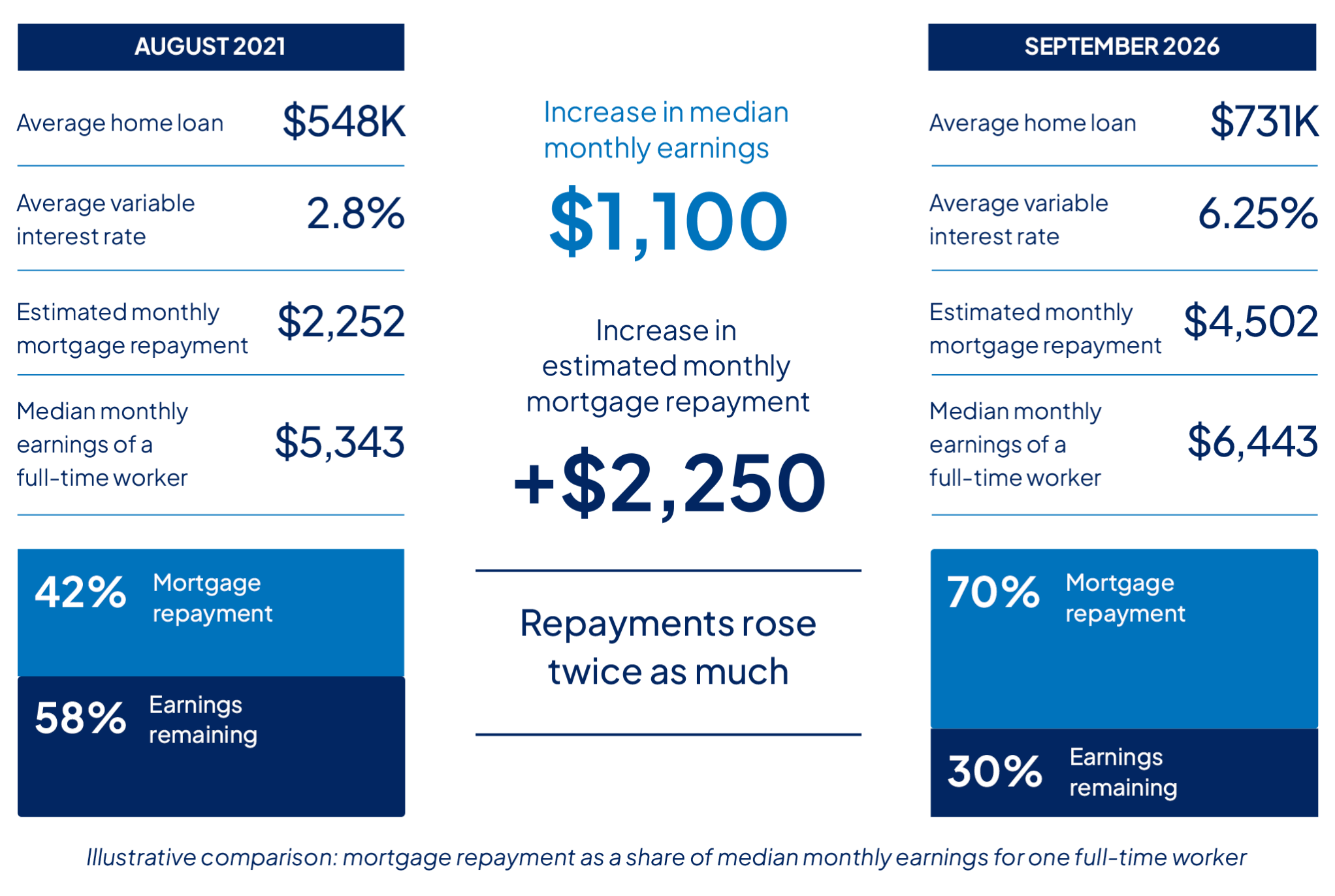
At a competitive rate of around 6.2%, monthly repayments on an average loan of $731,000* would be $4,502.
Compare that with five years ago*, when the average loan was $548,000 and the average variable interest rate was 2.8%. Monthly repayments were just $2,252 – half what they are today.
So how are households finding the extra cash to cover much higher repayments?
Median monthly earnings for a full-time worker were $6,443 in August 2025, around $1,100 more than in August 2021. This suggests wage growth has at least partially closed the gap, particularly for dual-income households.
However, Australians whose incomes have not kept pace – including those who have taken a career break for caring responsibilities – may be facing a widening hole in their household budgets.
Mortgage repayments have risen faster than earnings.
*Australian Bureau of Statistics – Lending Indicators, latest release
Comparison of mortgage repayments between 2021 and 2026
| August 2021 | September 2026 | |
|---|---|---|
| Average home loan | $548,000 | $731,000 |
| Average variable interest rate | 2.8% | 6.25% |
| Estimated monthly mortgage repayment | $2,252 | $4,502 |
| Median monthly earnings of a full-time worker | $5,343 | $6,443 |
| Mortgage repayment | 42% | 70% |
| Earnings remaining | 58% | 30% |
Repayments rose twice as much
Increase in median monthly earnings: $1,100
Increase in estimated monthly mortgage repayment: $2,250
Mortgage stress rising
46% of borrowers said they were concerned about servicing their mortgage over the next 12 months but despite rising pressure, 35% of longer-term homeowners said they had never refinanced, while 22% had not reviewed their rate or refinanced in five years or more, potentially missing out on more competitive deals that have since become available.
53% of mortgagors also admitted they did not know their current interest rate.
Buyers stay mum
Around a quarter of homeowners received support from the Bank of Mum and Dad to purchase a property. This included 6% who used their parents as guarantors, 7% who received an interest-free loan and 5% who lived with family rent-free while saving a deposit.
Only 5% said their parents chipped in towards a deposit, with recipients receiving a median gift of $50,000.
Millennial and Gen Z homeowners were much more likely to have leaned on their parents for support than their parents were themselves.
Just 8% of people aged 65 and over relied on familial support compared to 50% of people aged 25-34.
Higher rates squeeze housing affordability
Property values may be trending down, but higher interest rates and larger loans have pushed housing affordability lower in 2026.
Compare the Market uses Cotality’s median property data to track the affordability of both houses and units across 3,363 suburbs. We compare median earnings with estimated repayments for each property type, assuming buyers have an 80% loan-to-value ratio.
We apply the commonly used housing-stress benchmark that households should spend no more than 30% of their income on repayments.
Buying harder solo
Singles paying off a loan on their own face the biggest affordability hurdle, with an average salary making properties affordable in just 2.83% of suburbs. In 2025, singles could afford properties in 6.24% of suburbs.
Couples had better prospects, with two average salaries making 38.61% of suburbs affordable, down from 53.63% last year.
Options shrinking
Brisbane was the least affordable capital, with just 12.76% of suburbs across Greater Brisbane accessible to couples earning two average salaries. Even historically accessible suburbs such as Acacia Ridge have fallen into the “unaffordable” category.
Adelaide also offered few affordable options, at 14.95%, followed by Sydney at 16.88% and Perth at 22.11%.
Although the number of affordable suburbs declined in Darwin, 90.48% remained affordable for couples.
Property type was another key factor. Units were affordable for couples in 55.10% of suburbs, compared with just 38.60% for houses.