EV Revolution Shifts Gears
The global oil crisis has sparked a boom in EV sales
Key takeaways
- Battery electric vehicles accounted for 24.2% of new-car sales in September 2026, up from 11.3% a year earlier, while plug-in hybrid sales rose 122.7% year-on-year.
- Compare the Market’s modelled comparison found an EV cost about $2,600 less a year to run than a petrol SUV, assuming home charging through a wall box at an average EV-plan rate of 6c/kWh.
- Average quoted comprehensive insurance for the sampled battery EVs rose 10.2% over 12 months to about $2,306, compared with a 6.6% rise to about $1,709 for the sampled hybrid and plug-in hybrid vehicles.


Almost one-in-four new cars sold in September 2026 were battery electric vehicles (EVs), with EVs accounting for 24.2% of the market, up from 11.3% a year earlier. Plug-in hybrid sales rose 122.7% year-on-year, while hybrid sales increased 20.7%, highlighting Australians’ growing appetite for electrified vehicles.*
The cheapest electric vehicle (EV) now costs from $19,990 before on-road costs.**
But while EV demand has surged, there’s one catch consumers need to look out for: insurance.
According to Compare the Market’s electric vehicle insurance index, the cost to comprehensively insure a full battery-electric vehicle has increased 10.2% on average, while hybrid models experienced a 6.6% average jump during the same 12 months.
Insuring a full EV costs about 35% more than a hybrid on average, with quotes sitting at around $2,300 per year versus $1,700.
*Source: Federal Chamber of Automotive Industries. **BYD Atto 1 Essential as at 16 October 2026.
Average quoted EV premiums
| March 2025 | March 2026 | Year-on-year difference (%) | |
|---|---|---|---|
| Average Quoted BEV Premium | $2,071 | $2,306 | +$235 (10%) |
| Average Quoted HEV/PHEV Premium | $1,597 | $1,709 | +$112 (6%) |
Annual car running costs
With the price gap between models narrowing, hybrid and electric vehicles are becoming a more accessible choice for some Australians.
To understand how much it can cost to keep a car on the road in Australia today, Compare the Market examined the running costs of three popular medium SUV models: a petrol Mitsubishi Outlander, a hybrid Toyota RAV4 and a fully electric BYD Sealion 7.
The EV was the cheapest to run, costing about $2,600 less per year than the petrol model. This was driven by several factors, including a reduced EV loan interest rate and significantly lower charging costs. EV energy plans can help keep charging costs to a minimum, while EV owners may also benefit from cheaper registration costs.
However, the figures assume an EV is charged using a wall box charger to take advantage of ultra-low overnight energy tariffs offered by some retailers, averaging just 6 cents per kilowatt-hour (kWh). Purchasing and installing a wall box charger could initially cost hundreds, if not thousands, of dollars, depending on the property.
Meanwhile, the hybrid vehicle also delivered significant running-cost savings, with its claimed fuel efficiency enabling owners to cut their annual petrol spend by almost $1,000 compared to a petrol-only model, assuming they drive 15,000 kilometres a year and pay an average fuel price of $1.84 per litre.
With the price gap between these models narrowing, hybrid and electric vehicles may no longer feel as out of reach for some Australians. And with petrol and diesel prices still exposed to global shocks, lower running costs could make the switch more compelling for drivers who can make an EV work for their circumstances.
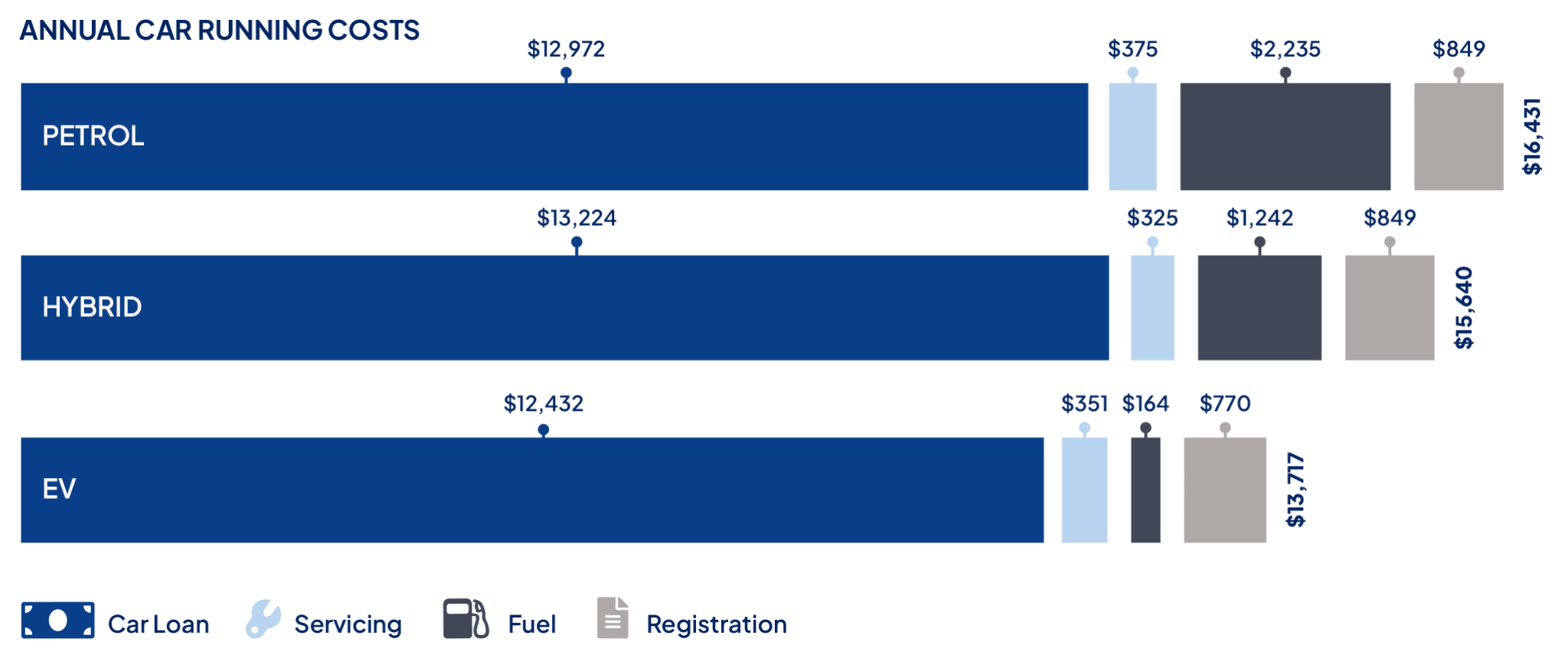
Annual car running costs
| Car Loan | Servicing | Fuel | Registration | Total | |
|---|---|---|---|---|---|
| Petrol | $12,972 | $375 | $2,235 | $849 | $16,431 |
| Hybrid | $13,224 | $325 | $1,242 | $849 | $15,640 |
| EV | $12,432 | $351 | $164 | $770 | $13,717 |
Hear from Compare the Market's Chief Executive of General Insurance, Adrian Taylor:
“Electric vehicles can reduce exposure to petrol-price shocks, but the purchase decision needs to account for finance, charging, insurance, servicing and registration together. For households with suitable home charging and the right energy plan, lower running costs can be compelling, but the upfront and insurance costs still need to stack up.”